gcimage

google
software

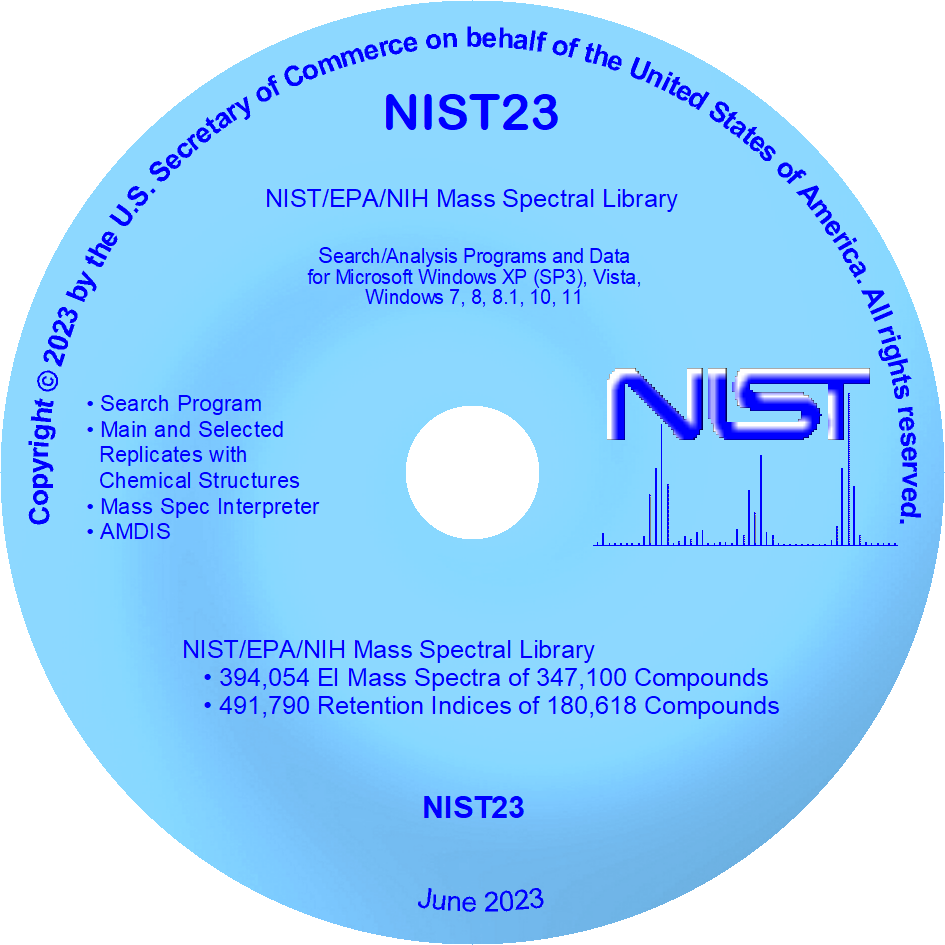
NIST/EPA/NIH Mass Spectral Library and Search Software (NIST11)

NIST11

NIST11 Online Order Options
For other order options, contact:

GC Image, LLC
PO Box 57403
Lincoln NE 68505-7403

email: info@gcimage.com
phone: +1.402.310.4503
fax: +1.402.436.2660
url: http://www.gcimage.com

NIST has released a new version of the NIST/EPA/NIH Mass Spectral Library (NIST11).  GC Image, a licensed distributor, offers discount pricing of only $1495 for a new license and $1095 for an upgrade from a previous version.  Discounts are available for simultaneous purchase of multiple licenses.

NIST11 consists of new and enhanced versions of:

  • NIST/EPA/NIH Electron Ionization (EI) Mass Spectral (MS) Database,
  • NIST non-spectral data (also sold separately),
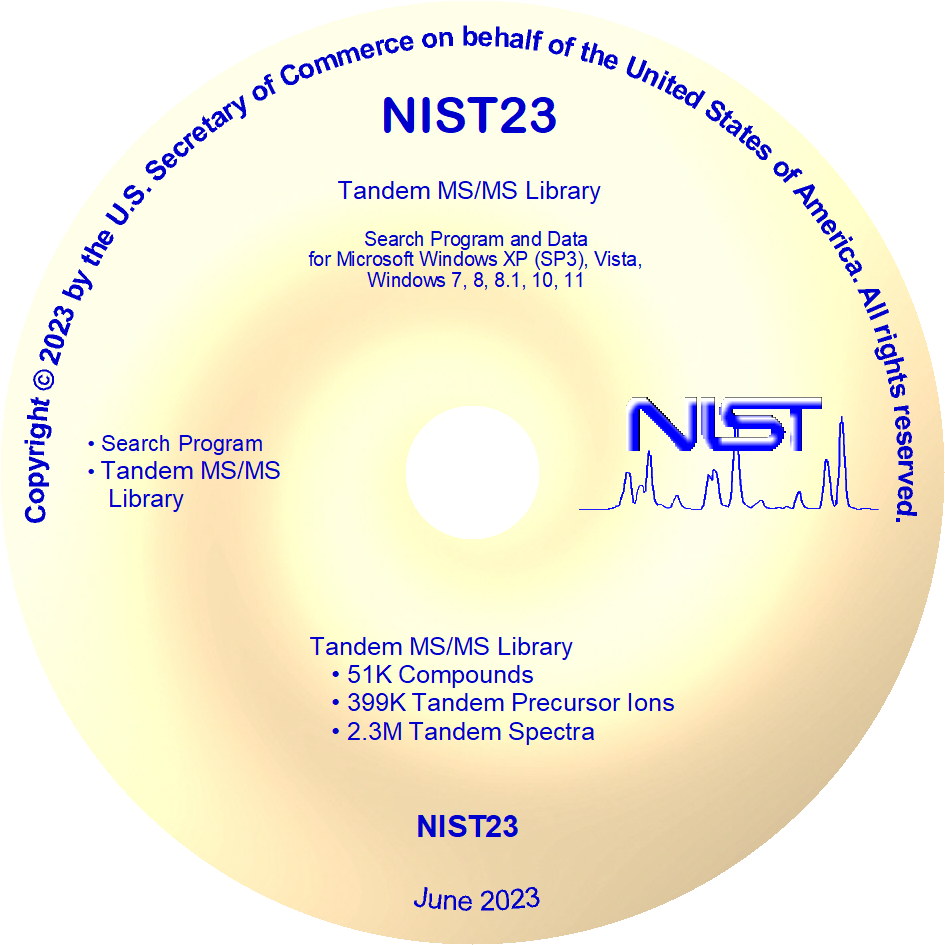
  • NIST MS/MS Database (also sold separately),
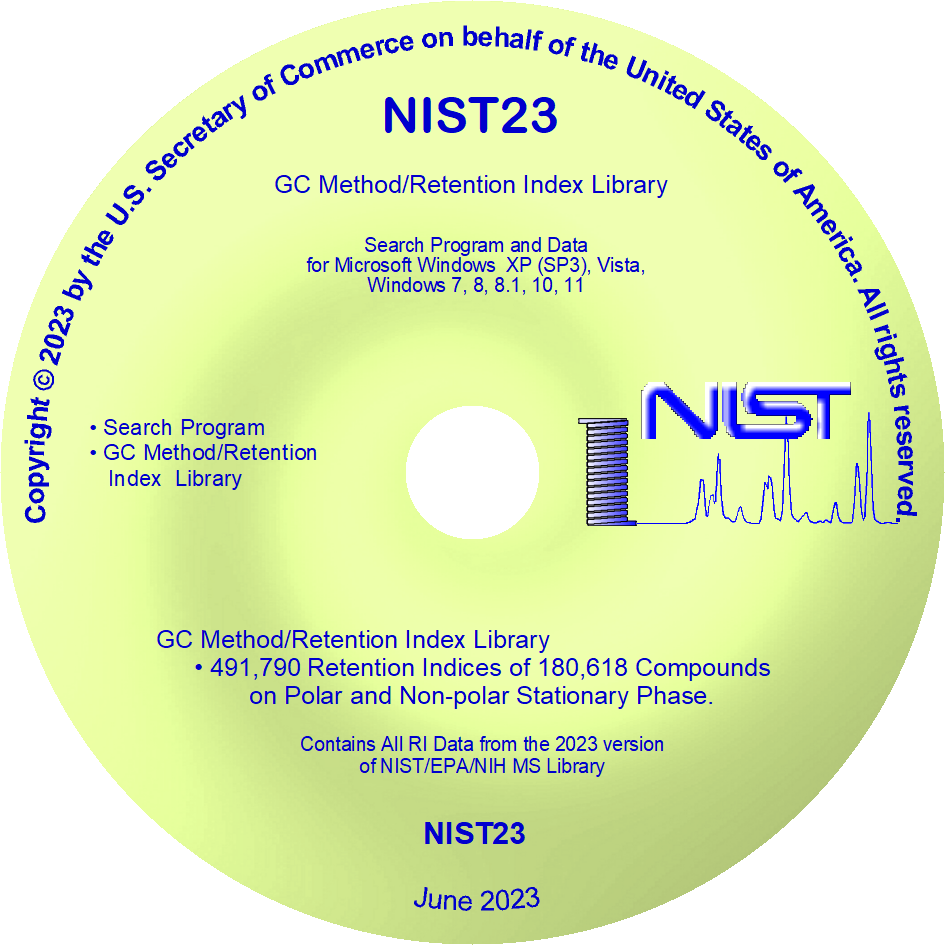
  • NIST GC Methods and Retention Index Database (also sold separately),
  • NIST Mass Spectral Search (MS Search) Program (v.2.0g),
  • MS Interpreter, and
  • Automated Mass Spectral Deconvolution and Identification System (AMDIS).

NIST11 contains major enhancements over NIST08:

  • The NIST/EPA/NIH Database of Electron Ionization Mass Spectra contains 243,893 EI mass spectra of 212,961 different compounds, an increase of almost 10% over NIST08.  This includes 23,433 new spectra of metabolites, drugs of abuse, derivatives of common compounds and many more, all measured specifically for this library.  Other major enhancements include many replacements with higher quality spectra, a thorough review of chemical names, and merging of the previous salts library with the main and replicates libraries.
  • The NIST Database of MS/MS spectra has undergone an even greater enhancement, with more than double the number of compounds.  Most spectra have been acquired on both ion trap and qtof/triple quad instruments, thereby increasing the number of spectra by more than six-fold compared to NIST08.  Spectra for the latter instrument classes have been acquired over a wide range to energies to ensure matching regardless of instrument collision settings.  Also, when available, high mass accuracy spectra are stored.  New spectra include metabolites, peptides (biologically active peptides and all di-peptides and tryptic tri-peptides), contaminants, lipids, and more.  The 2011 version contains 10,665 ion trap spectra for 9,194 different ions of 4,628 compounds, and 85,344 collision cell spectra (qtof and triple quad) for 7,172 different ions of 3,877 compounds.
  • An updated GC Methods and Retention Index Library contains 346,757 GC Methods with Retention Index (RI) values for 70,835 compounds, a 61% increase from NIST08.  The number of compounds with with RI data in the EI library is 38,648, an increase of 76%.  In addition, an Estimated Kovats RI together with a confidence interval is displayed for many compounds based on the structure associated with the spectrum.  MS Search will calculate RI values for structures submitted by users.
  • The NIST MS Search Program, now permits high mass accuracy mass searching and many asked for new features.  Click here for a fuller description of the new NIST MS Search Program.  AMDIS (Automated Deconvolution and Identification System) is significantly updated for GC/MS analysis.  The new MS Interpreter works with exact mass for both GC/MS and MS/MS fragmentation.
NIST has published a What's New in NIST11 and a Historical Perspective of NIST11 with additional information.

Some components of NIST11 are available separately:

The NIST08 demo version is available here.

The NIST MS Search Program (Version 2.0f, build 8 Oct 2008) and other information about the software is available here.

  
NIST11 GC Methods & RI Database

NIST GC Methods and Retention Index Database

NIST has released separately the retention index data from the NIST/EPA/NIH MS Library.  The Retention Index Database package is a comprehensive collection of gas-phase retention index data together with a standalone search program.  The search program accesses all RI information contained in the 2011 version of the NIST/EPA/NIH 2011 Mass Spectral Library).  This includes 346,757 annotated Kovats Retention Index (RI) values for 70,835 compounds, a 61% increase in the number of compounds.  The annotations include literature source and measurement conditions.  The number of compounds with RI data in the EI Database, mainlib, is 38,648, an increase of 76%.  In addition, for many compounds in the database an Estimated Kovats Retention Index (RI) together with a confidence interval is displayed based on the structure associated with the spectrum.

This product retrieves RI values with their corresponding GC methods by molecular weight, formula, name, CAS registry number, and, most importantly, chemical structures that can be submitted from various structure-drawing programs.  Look up can be constrained to elements present, numbers of each element present, and name strings for the main database name and synonyms present for many of the compounds contained in this unique Database.  This program also estimates RI values for each compound based on structure using NIST developed and published algorithms.

Search results can be limited to column type (packed or capillary), stationary phase type (polar, non-polar), temperature program type (isothermal or ramped), and data type (Kovats or Lee index).  Each GC method has details about the column length, diameter, and stationary phase loading along with the full literature citation.

  
NIST11 GC MS/MS Database

NIST MS/MS Database

The NIST Library of MS/MS spectra has been greatly enhanced.  The new collection more than doubles the number of compounds represented.  Most spectra have been acquired on both ion trap and qtof/triple quad instruments, thereby increasing the number of spectra more than six-fold compared to the 2008 version.  Spectra for the latter instrument classes have been acquired over a wide range of energies to ensure matching regardless of instrument collision settings.  Also, when available, high mass accuracy spectra are stored.  New spectra include metabolites, peptides (biologically active peptides and all di-peptides and tryptic tripeptides), contaminants, lipids and more.  The 2011 version contains 10,065 ion trap spectra for 9,194 different ions of 4,628 compounds, and 85,344 collision cell spectra (qtof and tandem quad) for 7,172 different ions of 3,877 compounds.

GC Image™ © 2001–2012 by GC Image, LLC